What's worth paying for
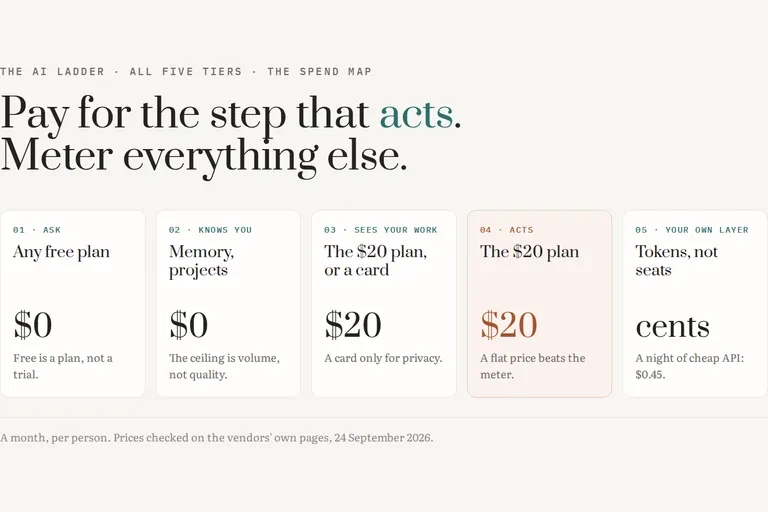
The ladder in this series runs in five steps: ask something, let it know you, let it see your work, let it act, then build your own layer. Nine pieces climbed it a tier or a company at a time. This one spans all five and asks what each of them left for its last section: what is any of it worth in money.
The premise I started with is the one most people hold. Better answers cost more, so the more you pay, the better the assistant. That is wrong in an instructive way. Almost nothing on these price pages sells you a smarter answer. It sells you room: more messages before a limit, more places the assistant may reach. Every price below was read off the vendor's own pricing page on 24 September 2026, in the unit that page uses, and if you are reading this much later, take the figures as the shape of the bill rather than the bill.
Tiers one and two: free is genuinely enough
The first two steps are asking and being known, and both are free at every company in this series. Not a trial, a plan. Claude's free plan includes chat on the web, the desktop and the phone, web search, memory across conversations, connectors, artifacts and up to five projects. Google lists Gemini at $0 a month with a Google account. OpenAI's own pricing documentation lists a Free plan at $0, next to Go at $8, Plus at $20 and Pro from $100 a month.
The first answer, then, is short: if what you do is ask questions and have them answered by something that remembers you, you do not need to pay anyone.
The ceiling is not quality. It is three walls, hit in this order. The first is volume: every plan counts use in a rolling five-hour window, and the free window is the smallest, and Claude's page promises Pro at least five times the free allowance per session. The second is the model: Claude's free plan carries Sonnet and Haiku, and Opus starts at Pro. The third is the surface, and it matters most here: the steps where the assistant sees your files and acts on them are where free stops. Claude Code is not on the free plan, and neither is Research.
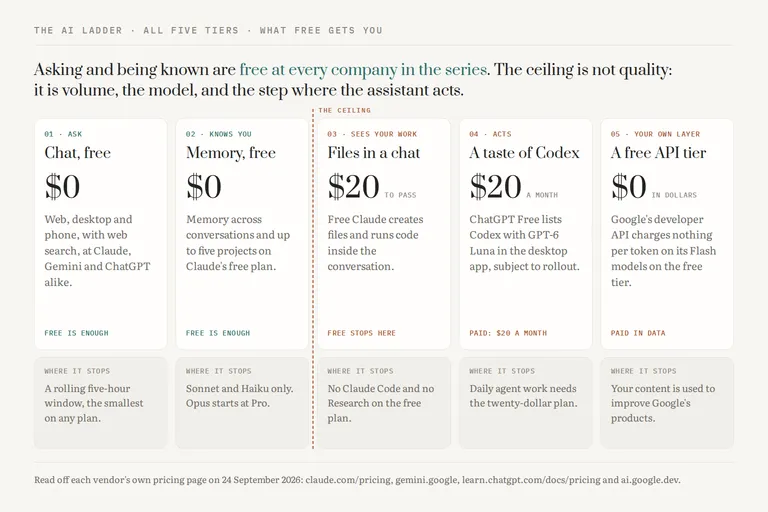
[ fig. Free is a plan rather than a trial for the first two steps. The ceiling sits where the assistant starts to see your files and act on them, and on the free API tier the price is your data. ]
One more free ceiling sits off the chat plans. Google's developer API has a free tier that charges nothing per token on its Flash models, and the pricing page is candid about the real price: on the free tier, your content is used to improve Google's products. Free is sometimes paid in data rather than dollars. For a question about a recipe that is a fair trade, and for a client's contract it is not.
Where a subscription pays for itself
The subscriptions sit on one shelf at one price. OpenAI's documentation lists Plus at $20 a month. Anthropic lists Claude Pro at $20 billed monthly, or $17 a month on an annual subscription, which is $200 paid up front. Google lists AI Pro at $19.99 a month in the United States. Above that sits a second shelf at about a hundred: Claude Max from $100 a month, ChatGPT Pro from $100, Google AI Ultra at $99.99.
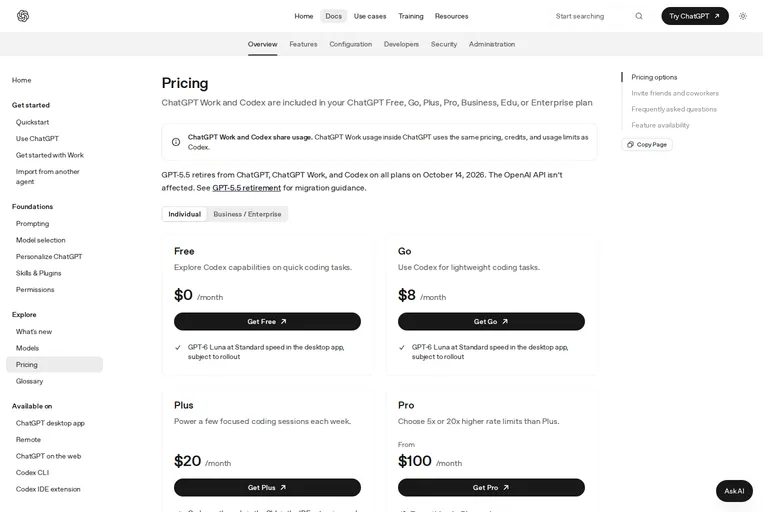
[ fig. OpenAI's own pricing documentation at learn.chatgpt.com/docs/pricing, captured on 24 September 2026. The consumer page at chatgpt.com/pricing refused the capture outright, so this is the documented price list instead. ]
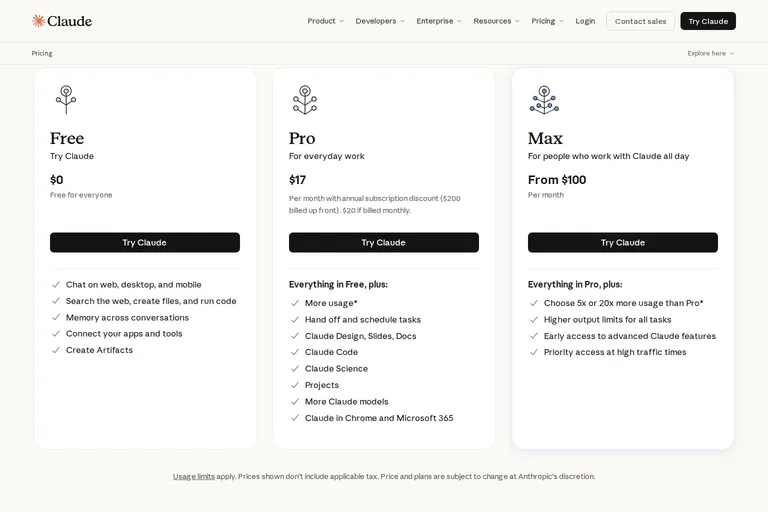
[ fig. claude.com/pricing, captured on 24 September 2026: the annual discount on Pro is written into the card itself, $200 up front against $20 a month. ]
The twenty-dollar plan. Who it is for: anyone who has hit the free window twice in one week, or who needs the step where the assistant acts. What it costs: $20 per person per month at all three companies, to within a cent, and $17 a month on Claude's annual billing. What it cannot do: give a better answer to a question the free plan already answered well. What I actually use it for: Claude Code, which comes with every paid Claude plan and is, as the Claude piece put it, most of my week.
The arithmetic that justifies it is the meter it replaces. Anthropic publishes API rates for the same models per million tokens: Sonnet 5 at $2 for input and $10 for output, Opus 5.5 at $4 and $20. An agent session is mostly reading, because every turn sends the working context again. Forty turns over a context that averages fifty thousand tokens is two million input tokens before anything is written, which is $4 of Sonnet 5 at the list rate, plus about sixty cents of output. Prompt caching cuts the rereads to $0.20 per million on a hit, and a careful session lands nearer $1.20. Either way, a session or two on most working days passes $20 of metered use inside the month. For that work the plan is not a luxury but the cheaper meter.
For chat alone the arithmetic runs the other way: an exchange costs around a cent at Sonnet 5's rate, so $20 is well over a thousand of them. People who pay twenty dollars to chat are buying the window, not the tokens.
The hundred-dollar shelf. Who it is for: someone who hits the twenty-dollar limit in the middle of the working day, most days. What it costs: from $100 a month at all three, which Claude's page describes as five or twenty times the Pro usage, billed monthly only. What it cannot do: think harder than the plan below it, because the pages sell it as usage, priority and early access, never as intelligence. What I actually use it for: it is not on my bill, so the field's version: worth it when the limit costs you more than eighty dollars of interrupted work a month, and the honest case against is that many buyers are paying not to think about the meter.
The local option's real break-even
The piece on running a model on your own machine measured the local half on my own box: a Ryzen 5 3600, 32 GB of DDR4 and an RTX 3060 with 12 GB. Those numbers stay as measured. A 27B model at 4-bit ran at about 5 tokens a second. The card that runs a 27B model at usable speed costs several hundred dollars and burns around 200 watts under load. A subscription costs about twenty dollars a month.
On one line the break-even looks simple: a twenty-dollar plan is $240 a year, so every hundred dollars of card is five months of subscription.
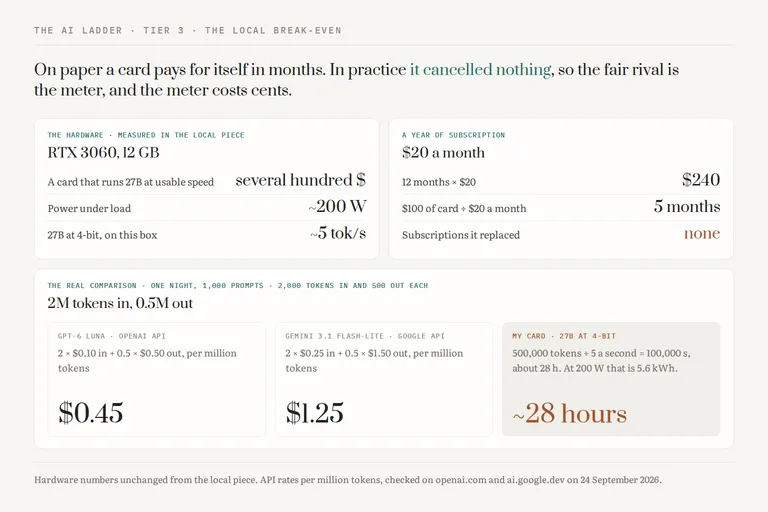
[ fig. On paper every hundred dollars of card is five months of a plan. The card cancelled nothing, so the real rival is the meter, and one night of a thousand prompts costs less than a dollar. ]
That arithmetic is wrong, and why it is wrong is the point of this section: the card did not cancel anything. I still pay for a subscription, because at 5 tokens a second a two-thousand-token answer takes seven minutes, and because on hard problems the gap to a frontier model has narrowed without closing. The local box is not a substitute for the plan. It is an addition to it.
The fair comparison is against the meter, and the meter has become very cheap. Take the job local is best at, a thousand prompts run overnight, each with two thousand tokens in and five hundred out. On OpenAI's GPT-6 Luna, listed at $0.10 per million input tokens and $0.50 per million output, the whole night costs 45 cents. On Google's Gemini 3.1 Flash-Lite, at $0.25 and $1.50, it is $1.25. On my card at 5 tokens a second, the half million output tokens alone take about 28 hours, and 28 hours at 200 watts is 5.6 kilowatt hours of electricity.
Local does not win on money, and it never did. It wins on what no price page offers, a prompt that never leaves the room. Who it is for: anyone whose reason is privacy, offline work or owning the tool. What it costs: a card you may already own, the electricity, and your evenings, since the software is free. What it cannot do: beat a cheap API on price, or a frontier model on hard work. What I actually use it for: Ollama on the Windows box with Open WebUI in front of it, as the everyday chat window for everything that stays local.
Regional prices, annual billing, and two tricks that are not tricks
Regional pricing is real and mostly small. I checked these pages from a server in Frankfurt, and the pages noticed: Google quoted AI Pro at €21.99, OpenAI's business page showed a Business seat at €21 beside its own $20, and Claude's stayed in dollars with a footnote that prices exclude tax. For the UAE, where I live, Google's page quotes AI Pro at AED 76.99 a month, about $20.96 at the dirham's fixed rate of 3.6725 to the dollar. That is about five per cent over the US price, the size of the UAE's VAT, which reads as the same plan with tax on top. No Gulf discount, no Gulf penalty.
Annual against monthly is where the page does the arithmetic for you. Claude Pro is $200 up front for a year against $240 paid month by month, which is $40 saved for a year of commitment. Team seats at both Anthropic and OpenAI are $20 on an annual plan and $25 monthly. Claude's hundred-dollar tier is monthly only.
The two tricks that are not tricks, because they are simply the rules read carefully:
Pay annually only for the plan you already know you will keep. The discount is real, about a sixth, and it is a discount on a year you have not lived yet. Buy it in month four, not in month one.
Pay per token for the work that is occasional. Codex and Claude Code both accept an API key instead of a plan, and Claude's page offers usage credits at API rates when a paid plan runs out. A second opinion once a week costs cents on a meter and twenty dollars on a plan.
The one that is a trick is buying through a region you do not live in. It saves little, as the dirham shows, and it rests on a card and an address that do not match.
Team and enterprise plans: what you are actually buying
Claude Team is for teams of 2 to 150, with a Standard seat at $20 a month billed annually and a Premium seat, with five times the usage, at $100. ChatGPT Business is $20 per user per month billed annually, for two or more users. Anthropic's Enterprise is $20 per seat per month plus usage at API rates, and OpenAI's is a conversation with sales.
Who it is for: anyone paying for more than one person's assistant, and anyone whose work is somebody else's data. What it costs: per seat, per month, close to the price of the personal plan, and on Anthropic's Enterprise the seat is a floor while the usage is a meter. What it cannot do: make the model better, since the seat buys the same models. What I actually use it for: nothing, since I buy for one person, so this is the field's view.
What you are buying is the envelope around the model: central billing, single sign-on, admin control over connectors, and one line that matters more than the rest. On Claude's personal plans the comparison table lists model training as opt-out. On Team it says no model training on your content by default, and OpenAI's business page says the same about business data. The team plan is not a bigger assistant. It is a contract.
What I pay for today, and the two things I would cut first
My own bill, ranked by what I would miss first.
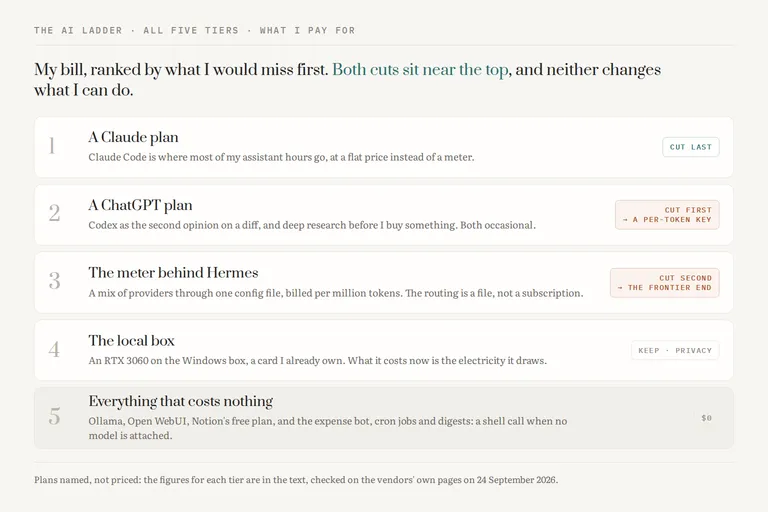
[ fig. My bill, ranked by what I would miss first. Both cuts sit near the top, and neither changes what I can do, only what I pay for doing it. ]
A Claude plan is at the top, and it is the last thing I would cut, because Claude Code is where most of my assistant hours go and it is included in the plan rather than metered. A ChatGPT plan is second, for Codex as the second opinion on a diff and for deep research before I buy something. Then the meter: I run Hermes with a mix of providers through one config, so the model routing is a file rather than a subscription, and it costs whatever those providers charge per million tokens. Then the local box, a card I already own and the electricity it draws. Below that, things that cost nothing: Ollama, Open WebUI, Notion's free plan, and the expense bot, the cron jobs and the digests on this server, which cost a shell call when no model is attached to the job.
The two I would cut first both sit near the top, which is the honest part. The ChatGPT plan goes first, because both of its jobs in my week are occasional, and occasional work is what a per-token key is for. The second is the expensive end of my own routing: any job in the Hermes config that runs on a frontier model out of habit rather than need. At GPT-6 Luna's rates a routine summary costs a fraction of a cent, and the gap between that and a frontier rate is paid on every run of every scheduled job. Neither cut changes what I can do. Both change what I pay for doing it.
So, the verdict. Pay a flat price for the step where the assistant acts, because that is where the plan beats the meter. Pay per token for everything occasional. Keep the free tiers for asking and being known, because they are genuinely enough, and buy a graphics card only for a reason no price page can sell you. Everything in this series is filed under The AI ladder, and the map starts again at the first piece.
More in the series
- From a chat box to a second brain: choosing your approach to AI
- Google's stack: what's actually in it
- ChatGPT like a pro
- Claude, end to end
- Desktop apps and editors
- Command Line Interface agents
- Running a model on your own machine
- The second brain that reads itself
- Automation: agents that run without you
- What's worth paying for reading